West Sumba
West Sumba is the part of Sumba where almost all of the island's early hospitality investment has been concentrated so far. It is a tropical and authentic area with few facilities, and tourism here is still very small-scale. Here I describe where the area stands, what positive and negative social impact your choice has when you buy or build there. The choice stays with you. I want you to know what comes with it.
- Development phase
- Exploration
- Tourism
- Very small-scale
- Open landscape
- A lot
- Airport
- Not international
Nihiwatu is the one established area. The rest is all growing. I expect these areas to develop in the coming years mainly as luxury enclaves and separate clusters, not as one continuous stretch of coast. Choose an area to read more.
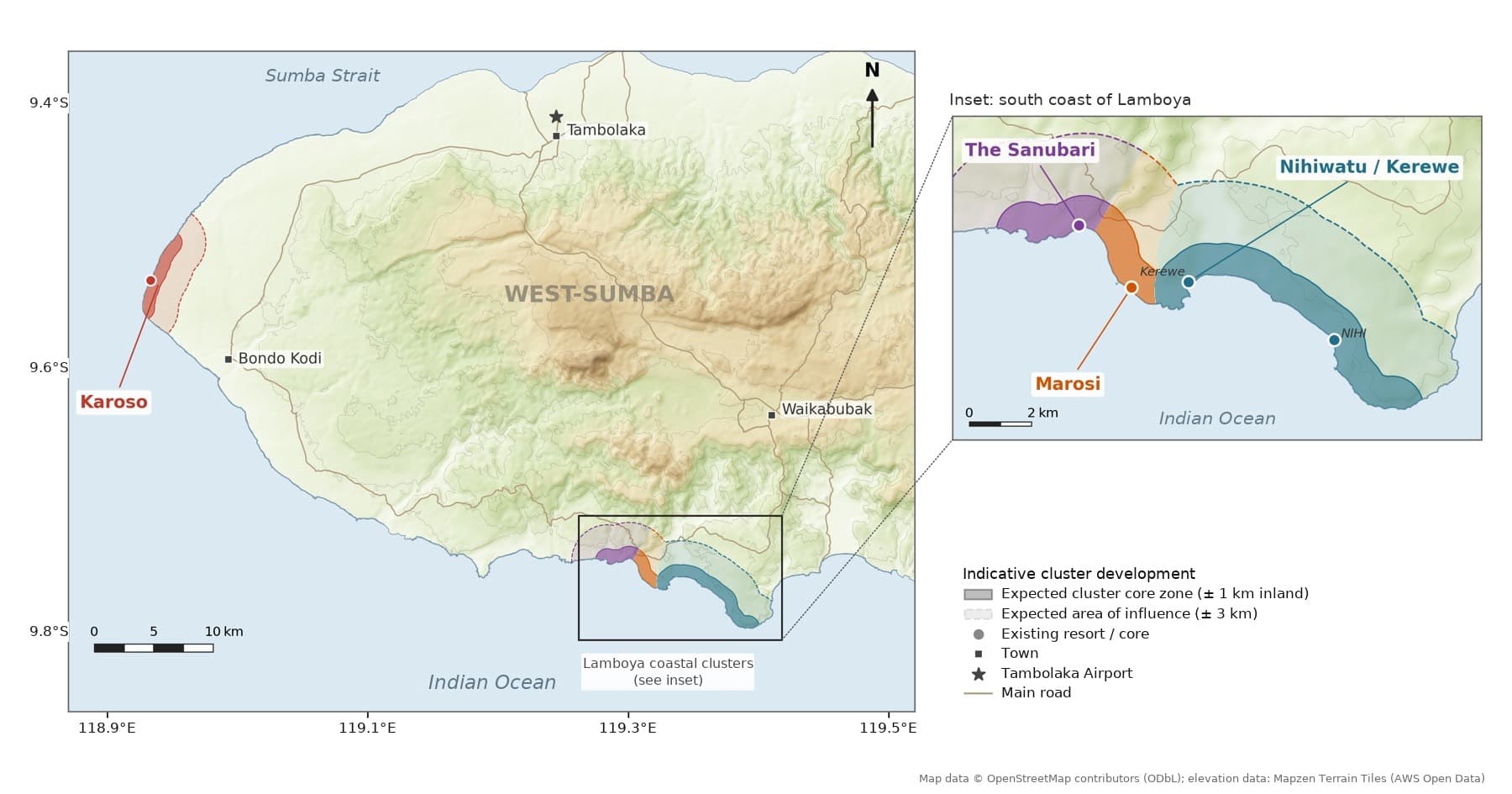
Click a pin to open that location.
Growing
Kerewe, Karosso, Tambolaka and Waikabubak. A lot of open landscape, a few projects that are slowly being added, and almost no facilities outside the hotels and resorts.
Established
Nihiwatu. Established because a resort has been here since the 1980s, with its own beach.
The meter
Each meter runs between two neutral end points. No judgement is attached. The dot shows where the area stands now.
Tourism
Very small-scaleTourism is still very small-scale. Few tourists come, and visitors mostly stay in luxury resorts, so tourism is barely visible in the streets. There are currently five semi-large projects on Sumba, a fraction of what exists on Bali or Lombok. I don't expect tourism on Sumba to grow quickly in the coming years. There is no international airport and at most two or three flights a day, and as long as that remains the case, tourism will not really take off. Where it does grow, I expect luxury enclaves and separate clusters rather than one continuous tourist coast.
Economy
One of the poorest areasThe economy is weak: this is one of the poorest areas of Indonesia, and the people here are very poor. Anyone who invests here can let the local area share in the benefits.
Living environment
A lot of open landscapeThe landscape is largely open and there is little building. The whole coast is still free, and you hardly feel any tourism.
Infrastructure
Fairly good, poor waterThe roads are generally fairly good, although there are some bad stretches. The network is not dense, but it doesn't need to be: the west is not densely populated and is inhabited mostly by traditional communities. Much of the traffic is scooters. I don't expect the infrastructure to become a problem in the long term. Outside the hotels and resorts there are practically no facilities. The water network is poor too, so developers often dig their own wells. They also tend to buy remote land and build the last stretch of road themselves, because the government doesn't.
Local interests
Very poor, little benefitThe people here are very poor and don't benefit much from tourism yet, because it is so small-scale. The projects do create employment, first in construction and later in hospitality. The developers who are here often came for the island and its people rather than for the most money, and many give something back, such as a small school. Sumba is more focused on adding value to society.
Social impact
Positive social impact
- For local residentsThe people in this area are very poor. The projects create employment: first in construction, and later in hospitality once a project is completed.
- For local residentsThe developers who are here often didn't go for the most money, but fell in love with the island and its people, and many want to give something back anyway: a small school for the community, or jobs for the people. It is also quite normal to do so to keep things running smoothly, for example with permits.
- For local residentsFor people who live largely self-sufficiently, selling a piece of land is often a way out: money, and children who can go to school. They often don't use that land anyway. In my experience they are glad of the opportunity.
- For the surroundingsThe projects are often self-sufficient, with solar panels, wells and their own roads. That suits a remote area, and it is a good development.
Negative social impact
- For the publicResorts that buy their own stretch of beach. If that becomes the norm, access to the beach will eventually disappear. I don't consider that a good development, and I wouldn't advise choosing that kind of project.
- For local residentsBuying land from people who live self-sufficiently is not uncontroversial. Some consider it ethically questionable, while the sellers themselves often see it as an opportunity.
My view
My view is that Sumba should remain an authentic island. You can feel that: people still live traditionally, the whole coast is free and there is little building. You hardly get a sense of tourism, and I find that beautiful. That tourism is not growing quickly for the time being does not bother me.
At the same time the people here are very poor, and investment that gives something back can help them. I see no contradiction in that, as long as it stays small-scale and the beach stays open to everyone.
I don't want to tell you what to do. I want to inform you. Know what your choice means, positive as well as negative, and then make the choice yourself.
This area profile provides information, not investment advice. The meters are qualitative estimates, not measurements.