Bukit Peninsula
The Bukit is currently one of the most popular and most heavily built-up parts of Bali. Here I describe where the area stands, what positive and negative social impact your choice has when you buy or build there. The choice stays with you. I want you to know what comes with it.
- Development phase
- Development–Consolidation
- Tourist intensity
- Very high
- Trend
- Increasingly popular
- Space
- Limited, a peninsula
The Bukit isn't one thing. Bingin and Padang Padang are currently the most popular areas, and Nusa Dua and Jimbaran have been developed for much longer. My expectation is that over the coming years the same shift will also take place in other areas: Ungasan, Melasti, Nyang Nyang, Pandawa and Balangan are starting to join them, see the map. A new road is also being built in the Uluwatu area, while the main connection from Jimbaran stays the same. Choose an area to read more.
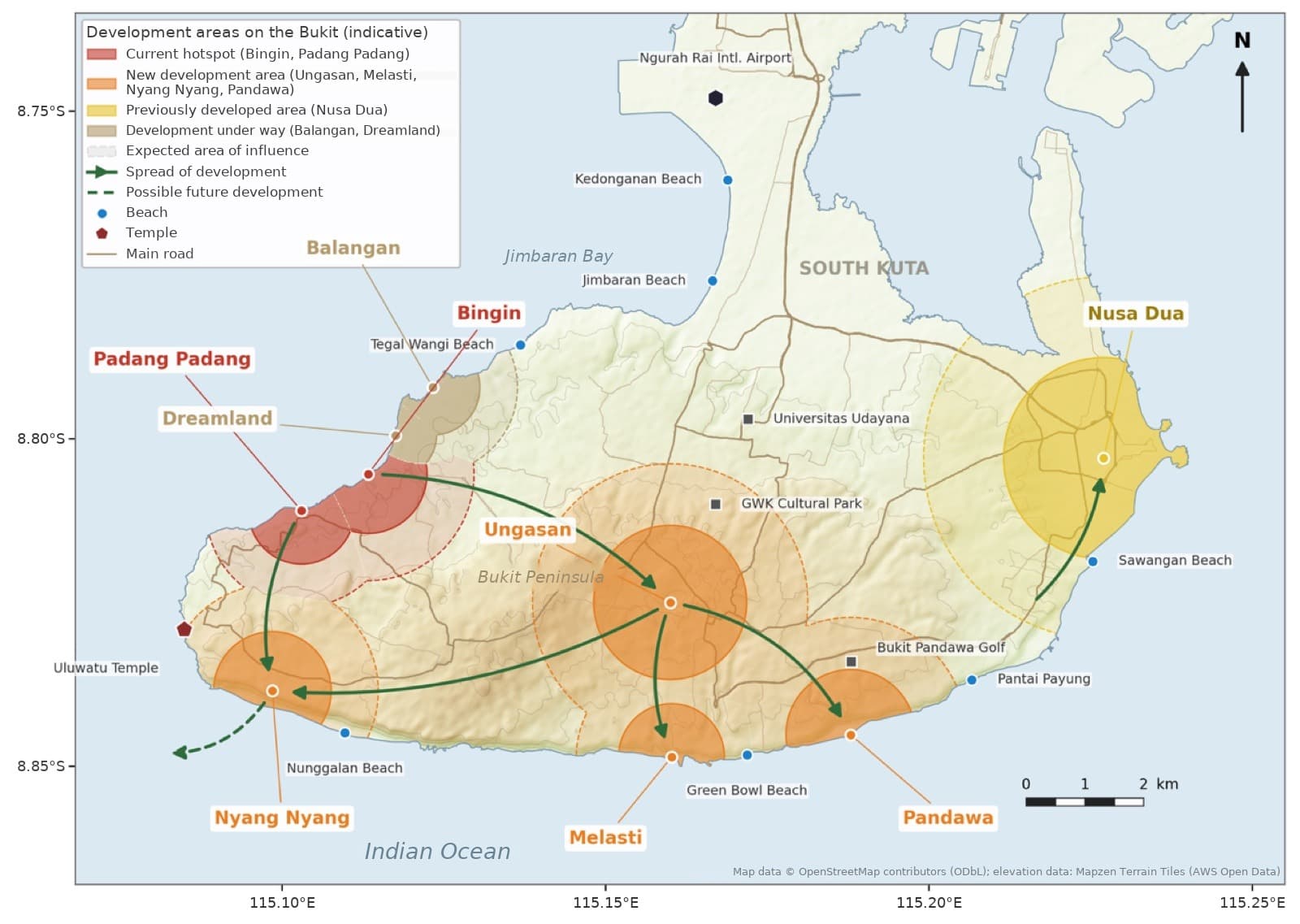
Click a pin to open that location.
Growing
Ungasan, Melasti, Nyang Nyang, Pandawa and Balangan. Cheaper, still room, and in the Development phase.
Hotspot
Bingin and Padang Padang. Expensive, busy and almost full. Bingin is close to Consolidation.
Established
Nusa Dua and Jimbaran. Developed for longer, with their own character and a different market.
The meter
Each meter runs between two neutral end points. No judgement is attached. The filled dot is where the area stands now, the hollow dot is what I expect over time.
Tourism
Trend: risingUluwatu is one of the most popular areas on Bali and the Bukit keeps getting busier. The whole Bukit is currently seen as the most interesting property area on Bali.
Economy
Land prices risingAn enormous amount is being invested and built.
Living environment
Expected: fullerOpen landscape is disappearing. Water arrives by truck from Jimbaran, because the limestone ground doesn't allow a regular pipe network. More villas means more transport, and that is less sustainable. In the past, building took place in the green zone. That is now regulated more strictly, and at Bingin buildings were demolished.
Infrastructure
New road under constructionUluwatu has one main connection from Jimbaran, and there are often traffic jams. Within Uluwatu a new connecting road is now being built. The access road stays the same, but inside the area the pressure eases. That is a good improvement, and it makes further tourism growth possible. The government will have to keep investing to cope with new villas and new tourism.
Local interests
Expected: more expensiveThere are two sides to this, which I explain below. The area creates a lot of work, and at the same time becomes more expensive for the people who have always lived here.
Social impact
Positive social impact
- For local residentsA lot of work: construction workers, Grab drivers, restaurants, hospitality and the drivers of the water trucks.
- For local residentsTo give an example: my own villa provides work, through the management, for at least one person who does the cleaning, and that is a full-time job. On top of that, several people at the office are involved who arrange things. During construction, around thirty-five people worked on the project, which consisted of three villas: more than ten people per villa. So it creates a lot of employment.
- For local residentsThe construction workers are glad of the work. By our standards their living conditions aren't always ideal, but they live there and are content.
- For the areaThe new road in Uluwatu and the space in Ungasan and Pandawa let the area keep growing.
Negative social impact
- For traffic and the surroundingsWater by truck and construction traffic, on roads that are already busy. I take part in that myself.
- For the surroundingsThe disappearance of open landscape.
- For local residentsAn area that is increasingly for tourists, digital nomads and Westerners.
- For local residentsLocal people selling parts of their land. They don't have to, but for many of them it is often the only logical option.
Local interests: two sides
Many new jobs in construction, restaurants and hospitality.
People who work here often can't live here, because it's too expensive. Many live in Denpasar, far away.
More visitors bring income for the people who work there.
In many places entry costs money. For tourists that's nothing, but for someone on a small daily wage it's a lot.
Selling or leasing land brings in a lot of money.
It can feel half forced, because it is so attractive. Land normally stays in the family, and then it goes anyway.
My view
The Bukit brings a lot: work for people in construction, restaurants and hospitality, and the area can still keep growing. At the same time open landscape is disappearing, water arrives by truck, and the area becomes more expensive for the people who have always lived here. There are two sides to it.
I'm not telling you not to buy here. I take part myself.
I don't want to tell you what to do. I want to inform you. Know what your choice means, positive as well as negative, and then make the choice yourself.
This area profile provides information, not investment advice. The meters are qualitative estimates, not measurements.