South Lombok
South Lombok is the main tourism zone of Lombok, with Mandalika, a state-planned zone, next to Kuta Lombok. Because of the topography, with its hills and mountains, development here will probably take place in coastal clusters rather than in one connected pattern, as is visible on Bali. Here I describe where the area stands, what positive and negative social impact your choice has when you buy or build there. The choice stays with you. I want you to know what comes with it.
- Tourism
- Mostly beach
- Open space
- Still a lot
- Land
- Still cheap
- Infrastructure
- Fairly good, Mandalika masterplan
Kuta Lombok is the hotspot. The other areas are all growing: there is still a lot of open space, and that is a reason many people come. Choose an area to read more.
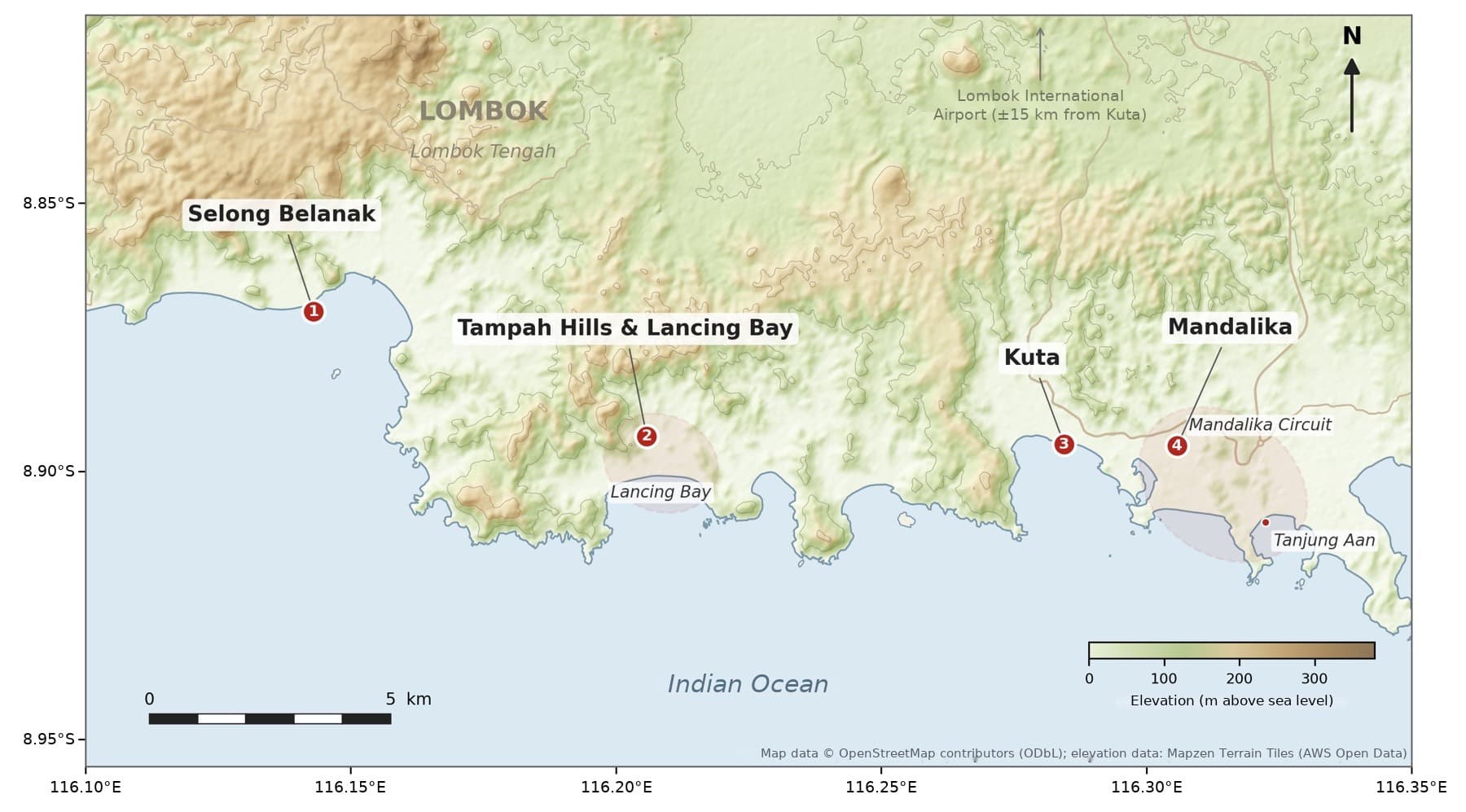
Click a pin to open that location.
Growing
Mandalika, Tanjung Aan, Tampah Hills and Selong Belanak. A lot of open space, land that is still cheap, and in Mandalika a state masterplan.
Hotspot
Kuta Lombok. The established town and gateway, with less open space than the rest.
The meter
Each meter runs between two neutral end points. No judgement is attached. The dot shows where the area stands now.
Tourism
IncreasingTourism is increasing, but it is nowhere near as busy as on Bali. At the moment the balance between development and tourism is healthy: it is not very touristy yet, and not overdeveloped.
Economy
Land still cheapLand is still cheap here, and that is a reason many people come. You can buy or build a villa with a beautiful view. The area gains investment and employment from it.
Living environment
A lot of open spaceThere is still an enormous amount of open space. In Kuta it is somewhat less; in the other areas there is still quite a lot. As more is built, part of that open landscape will be lost.
Infrastructure
Fairly good, masterplanIn principle the infrastructure is fairly good in many parts of Lombok, and in Mandalika especially: the government built good infrastructure there before tourism really got going. Mandalika is a real masterplan. In the other areas the infrastructure and the water network are fine for now, but you don't know how that will develop later, because the government is less involved there.
Local interests
Few residentsThe local environment is fine. Not an enormous number of people live in the area, and the people who do live there benefit greatly from the beach tourism. Not for everyone, though. At Tanjung Aan, restaurants and warungs of local people were removed by the government last year, after the land was sold to large developers. According to the government they stood there without permission.
Social impact
Positive social impact
- For local residentsWork in tourism. The people who live here benefit greatly from the beach tourism.
- For the areaIn Mandalika, good infrastructure that the government built before tourism got going.
Negative social impact
- For the surroundingsThe open landscape disappears as more is built. There is still an enormous amount of space now, but that will change.
- For utilitiesOutside Mandalika the infrastructure and the water network are fine now, but the government is less involved there. How that develops later is uncertain.
- For local residentsLand that goes to large developers, at the expense of local entrepreneurs, as in the example at Tanjung Aan.
My view
I'm not against South Lombok developing. Lombok may well become a good tourist area, and perhaps it takes some pressure off Bali.
But Lombok should learn from Bali. There, building went faster than planning, and you see it now in traffic, water, waste and residents who live further and further from the coast. Growth is not the problem, the order is. So:
- First roads, water and facilities, then building.
- Establish coastal zones and zoning while there is still space.
- Enforce the rules, also when a lot of money is involved.
- Keep the local residents in mind.
I don't want to tell you what to do. I want to inform you. Know what your choice means, positive as well as negative, and then make the choice yourself.
This area profile provides information, not investment advice. The meters are qualitative estimates, not measurements.