West & Southwest Coast
This is Bali's best-known stretch of coast, and at the moment its economic core. I first saw Canggu in 2015, on my first trip to Bali, and back then barely any of what seems obvious today existed. Here I describe where the coast stands now, what positive and negative social impact your choice has when you buy or build there. The choice stays with you. I want you to know what comes with it.
- Development phase
- Development–Stagnation
- Tourist intensity
- Very high
- Development direction
- West
- Open space
- Limited
The coast isn't one thing. Kuta, Legian and Seminyak have been developed for much longer. Canggu and Pererenan are the hotspot now, with Kerobokan and Umalas in between. Seseh, Cemagi, Nyanyi and Kedungu are growing. Over the decades the development has moved step by step westward, from Kuta to Legian, Seminyak, Canggu and now beyond. The pattern I derive from this: development starts at an attractive hotspot and moves on to the neighbouring area as land becomes scarcer and more expensive, and in the new area the same cycle can start again. Choose an area to read more.
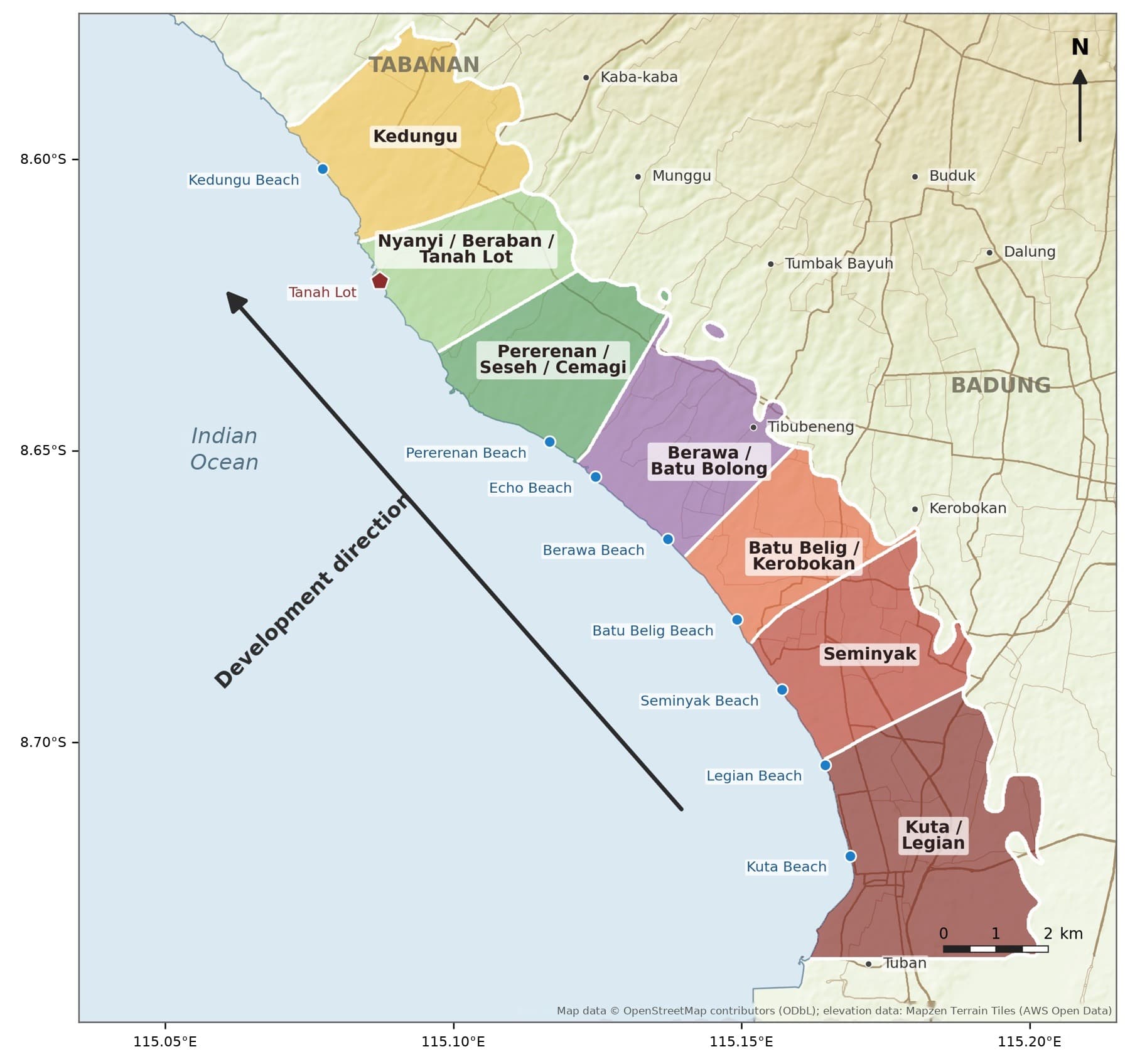
Click a pin to open that location.
Growing
Seseh, Cemagi, Nyanyi and Kedungu. Further north-west, where the growth is heading now.
Hotspot
Canggu and Pererenan. Canggu is between Consolidation and Stagnation, Pererenan is in Development heading toward Consolidation.
In between
Kerobokan and Umalas. They sit between the established areas and the hotspot.
Established
Seminyak, Kuta and Legian. Developed for the longest. Kuta is in the Stagnation phase, Seminyak in Consolidation heading toward Stagnation.
The meter
Each meter runs between two neutral end points. No judgement is attached. The dot shows where the area stands now.
Tourism
The hotspot keeps movingKuta, Legian and Seminyak have been established for a long time. Canggu and Pererenan are the hotspot at the moment. The development keeps shifting north-west: where space in the south runs out, growth moves on to the areas further along. I expect the hotspot to sit around Kedungu in roughly ten to twenty years, with the areas beyond it becoming popular then. You see the same mechanism every time.
Economy
Economic core of BaliThis is the largest tourist centre of Bali and, at the moment, its most important economic core. Demand is high: more villas are being built here than anywhere else on the island, and more have already been built. A great many Indonesians work here in hospitality, and this is where most people work.
Living environment
Floods in heavy rainIn Seminyak, Legian and parts of Kerobokan there is a bathtub effect: with heavy rain, flooding follows. In Canggu, many villas were built in the past without the right permits, at a time when the rules existed but enforcement was less strict. A single villa is not a big problem in itself. Hundreds of separate projects together are a large part of it. Much of the building took place on former rice fields.
Infrastructure
Differs per stretchThe Sunset Road is very good. Toward Umalas and Canggu the infrastructure isn't great: it wasn't built to handle this number of villas and people. The result is traffic congestion. Pererenan has less of it, because better roads have been built there.
Local interests
Work, no housingThere are two sides to this, which I explain below. It is a tourist strip along the beach, with a lot of work and housing that the people who work there can't afford.
Social impact
Positive social impact
- For local residentsA lot of work, especially in hospitality and the restaurant and café trade.
- For the areaThe most important economic core of Bali at the moment: this is where most people work.
- For traffic and accessGood main roads in places, like the Sunset Road, and in Pererenan better roads have been built, so it is less busy than Canggu.
- For the areaIn the north-west, around Seseh, Cemagi, Nyanyi and Kedungu, the growth is now heading that way. That brings more employment in those areas too.
Negative social impact
- For traffic and accessTraffic congestion, on roads that weren't built for this number of villas.
- For the surroundingsFlooding when it rains heavily, in Seminyak, Legian and parts of Kerobokan.
- For local residentsAn area that is increasingly geared to tourists, while the people who work there can't afford to live there.
- For the surroundingsRice fields have disappeared and the coast is built up almost continuously, without roads and drainage keeping pace.
- For the surroundingsWaste processing has not kept up with the growth. Waste ends up along roads and rivers, and is often burned in the open air.
Local interests: two sides
A lot of work in hospitality and the restaurant and café trade, in the economic core of Bali.
Living here is unaffordable for the people who work here. Most of them live in Denpasar and travel to Canggu and the surrounding areas.
Selling or leasing land brings in a lot of money.
It can feel half forced, because it is so attractive. Land normally stays in the family, and then it goes anyway.
My view
This coast is the economic core of Bali and offers a lot of work. It is also where the pressure is greatest: traffic, flooding when it rains heavily, and housing that the people who work here can't afford. That the hotspot keeps moving north-west means the same trade-offs are now coming to the areas there.
I don't want to tell you what to do. I want to inform you. Know what your choice means, positive as well as negative, and then make the choice yourself.
This area profile provides information, not investment advice. The meters are qualitative estimates, not measurements.